
Key takeaways
- Micro markets can raise average order value, but weak stops still fail on labor and travel time.
- Route buyers are asking for location-level proof, not just total revenue or seller summaries.
- Cashless fees, telemetry costs, shrink, spoilage, and commissions should be modeled before rollout.
- Smart coolers work best when they improve an already efficient route, not when they stretch one.
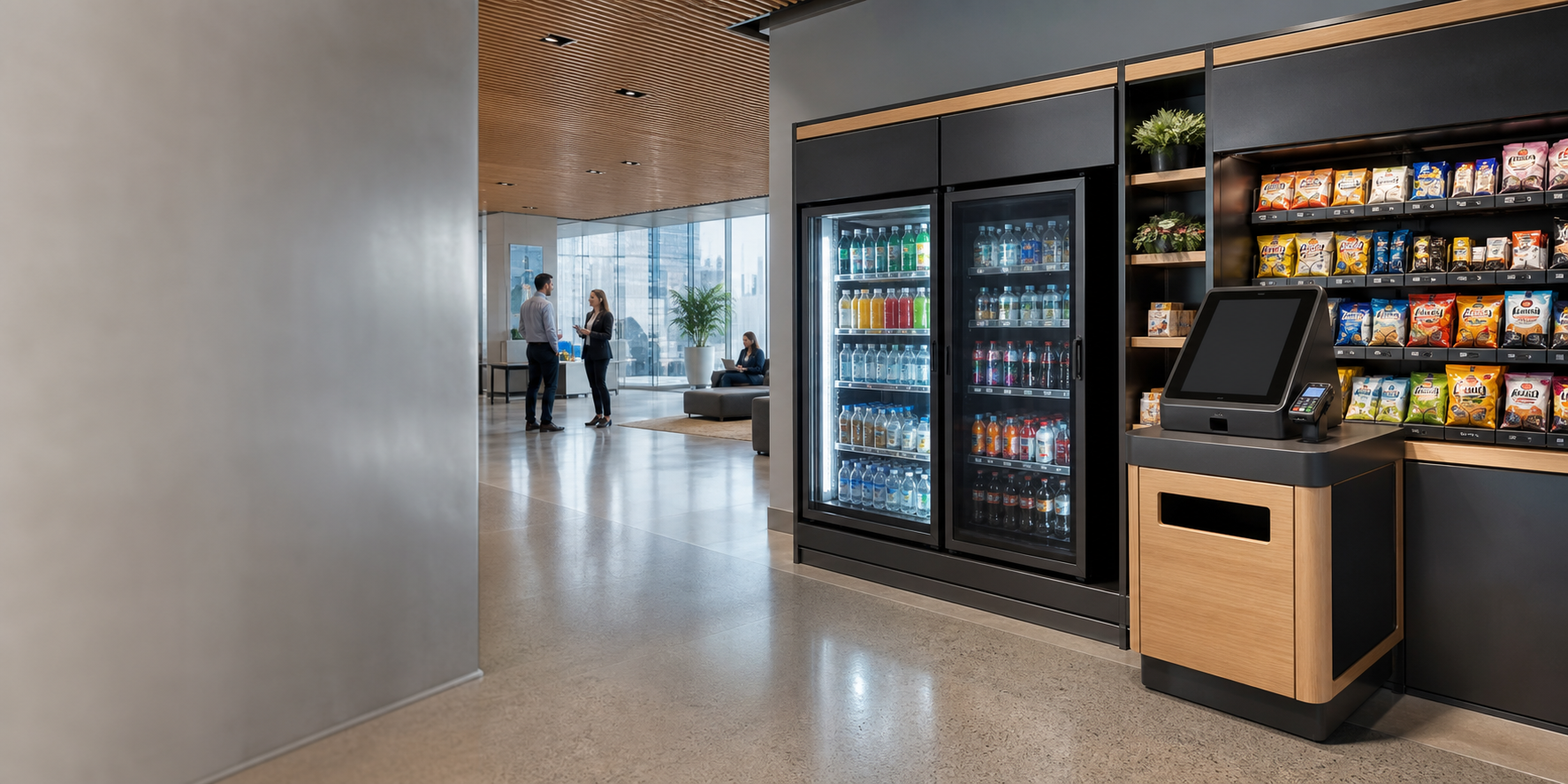
Micro markets are getting more attention from suppliers, landlords, and workplace teams, especially in offices that want a more flexible food and beverage setup than a row of machines. The appeal is obvious: more product variety, better merchandising, cashless checkout, and a stronger breakroom story for the location.
The less glamorous part is still the part operators have to solve first. A location that looks good in a sales deck can become thin quickly if it needs too many touches, sits outside an efficient route, or produces uneven sales after the first few weeks.
That is why buyers are asking for more proof before they value a route or approve a format change. Card reader screenshots, service logs, location-level sales history, commission terms, and equipment condition are moving from nice-to-have details to basic diligence.
The route math operators should run first
Before a vending operator adds a smart cooler or converts a machine bank into a micro market, the first model should be plain: revenue by location, gross margin by category, service minutes, travel time, commission, payment fees, shrink, and equipment cost. None of those numbers has to be perfect, but each one has to be visible.
The mistake is comparing formats only by sales potential. A cooler with more premium products may produce stronger tickets, but it can also add spoilage, product rotation, planogram work, and loss-control tasks. A traditional vending bank may look less exciting, but it can be more predictable if the location is compact, accessible, and already on an efficient route.
| Decision area | Traditional vending question | Micro market or smart cooler question |
|---|---|---|
| Service labor | How often do machines need fills and fixes? | How much time is added for merchandising, cleaning, rotation, and checkout support? |
| Product mix | Which snacks and drinks turn reliably? | Can fresh, healthy, or premium items sell before spoilage or discounting? |
| Payment cost | What are reader fees, processing fees, and settlement timing? | How do kiosk, app, loyalty, or cooler-platform fees affect margin? |
| Loss control | What is shrink from jams, refunds, or machine access? | What is shrink from open access, missed scans, spoilage, and poor camera coverage? |
What operators should watch
- Service frequency by location, not just total route revenue.
- Reader fees, telemetry costs, and settlement timing on cashless machines.
- Fresh food spoilage and shrink in micro market plans.
- Whether the location has enough population density after hybrid work patterns settle.
Questions to ask before changing a location
For the location manager
- How many people use the breakroom on a normal Tuesday, not just on event days?
- Will the location support better signage, cameras, payroll deduction, or employee messaging?
- Who handles access when equipment needs service after normal hours?
For the supplier or platform
- Which fees are fixed, which are transaction-based, and which change with volume?
- What data can be exported by location, machine, product category, and date range?
- What happens when a kiosk, reader, or cooler lock fails during a busy service window?
For a route buyer
- Can the seller show sales history by asset and location instead of only route totals?
- Are commissions, subsidies, rent, or service expectations documented in writing?
- How much equipment is owned, financed, leased, or tied to a supplier agreement?
Operator playbook
Move
Build a location model before changing equipment: population, access, service minutes, current sales, expected product mix, payment fees, spoilage, shrink, commission, and travel time.
Move
Separate the excitement of a new format from the account's ability to support it. A smart cooler or micro market should make a good stop better, not distract from a weak stop.
Move
Use a small test group before committing fleet-wide. Compare machine-only, smart cooler, and open-market formats on the same route economics.
Questions to ask before acting
These are the questions Vending Press would want answered before treating the story as an operating decision instead of a headline.
- Can the seller show location-level sales history, not only route totals?
- What happens to margin after reader fees, platform fees, shrink, spoilage, and commissions?
- Does the account have enough traffic on normal days, not just launch week or event days?
Metrics to track
Red flags in a route packet
Rich route materials make a buyer's job easier. Thin materials make the buyer discount the deal. A route packet that only shows gross sales, a list of locations, and a few machine photos leaves too much unknown. Stronger packets include card-reader reports, commission terms, repair notes, product mix, machine age, service cadence, and the reason each location is being sold.
- No location-level sales history.
- No proof of commission terms or placement rights.
- No explanation of recent revenue drops or unusual seasonal spikes.
- No separation between machine revenue, micro market revenue, OCS, pantry, and subsidies.
- No repair history for high-value equipment or refrigeration assets.
Why it matters
A smart cooler can improve a strong stop, but it does not rescue a weak one by itself. For operators and route buyers, the better question is not whether micro markets are the future. It is where the format earns its service time.
Bottom line
The best operators will not treat micro markets as a separate business from vending. They will treat them as another format inside the same route economics. If the stop is dense, accessible, measurable, and supported by the location, a market-style format can create a better account. If those pieces are missing, the upgrade may only make a weak stop more complicated.
Reporting notes
This sample briefing is written as an operator-focused explainer. Future Vending Press articles should add named sources, original operator interviews, supplier documentation, location examples, and links to public records or company announcements when available.
Where advertisers fit
Best-fit sponsors include micro market platforms, smart cooler vendors, payment processors, telemetry providers, route finance companies, and suppliers with products that improve account economics.
Review Vending Press advertising options